Case Study | Bonito Deco
Brand Refresh & E-Commerce Experience
Overview
While working at Bonito Deco as an Alibaba sales operator, I identified the opportunity to improve the brand’s digital presence. Despite not having a formal background in design, I initiated and led a six-month rebranding and e-commerce website project. Through self-directed learning and collaboration, I successfully transformed the company’s static online catalog into a dynamic shopping experience—significantly enhancing usability and increasing international order efficiency.
🛠 Tools Used
- Design: Photoshop, Illustrator, InDesign
- Web: Collaborated with a freelance developer (WordPress, WooCommerce)
- Collaboration: Google Meet, Google Docs, Google Drive
Duration: 6 Months
My Role: Project lead & brand strategy, managing an external designer and web developer
Problem Background
Bonito Deco is a small lifestyle brand specializing in customizable honeycomb blinds, with a focus on overseas markets. At the time, the website faced several critical issues:
- The site was static and lacked any e-commerce functionality. The logo and visual branding were outdated and didn’t reflect product quality
- The ordering process relied on contact forms, causing high customer drop-off
- The brand struggled to engage its ideal target audience
My Role & Responsibilities
Although I wasn’t formally trained in design, I took initiative and ownership of the entire project, acting as both a UX thinker and project manager. My contributions included:
- Planning the end-to-end redesign strategy and aligning it with business goals
- Analyzing competitors’ websites to define architecture and UX flow tailored to our product
- Defined the brand direction (keywords, tone, color, and typography references) and worked with an external designer to create the logo and visual system
- Writing and editing all copy and designing marketing assets using Photoshop, Illustrator, InDesign and Canva
- Managing the SEO structure and building a content marketing plan via blog and social platforms
Design Process
1. Discovery & Research
- Conducted informal stakeholder interviews with the founder to understand business goals and pain points.
Audited the original website to identify usability barriers, outdated branding, and lack of purchase flow. - Reviewed 10+ competitor websites in the home decor and window treatment industry.
- Summarized key UX patterns, user expectations, and content features from market leaders.
2. Define Goals & User Needs
- Clarified key project goals:
- Enable global buyers to complete purchases without manual communication
- Reflect a more elegant, modern brand image aligned with quality
- Support custom-size orders and real-time shipping calculation
- Identified target users: international DIY homeowners and small interior studios seeking direct order convenience.
3. Information Architecture
- Structured product pages based on user expectations: clear specifications, visual samples, and guidance for custom sizing.
- Mapped out a streamlined shopping flow:
“Choose a window blind system & fabric color ( automatically shows the unit price in Square meters)→Choose the order quantity→ checkout ( automatically calculates the shipping cost when the customer inputs their shipping address)”
- Created an intuitive global checkout system to reduce back-and-forth communication
- Designed new site navigation and language structure for English-speaking users.
4. Visual & Brand Design
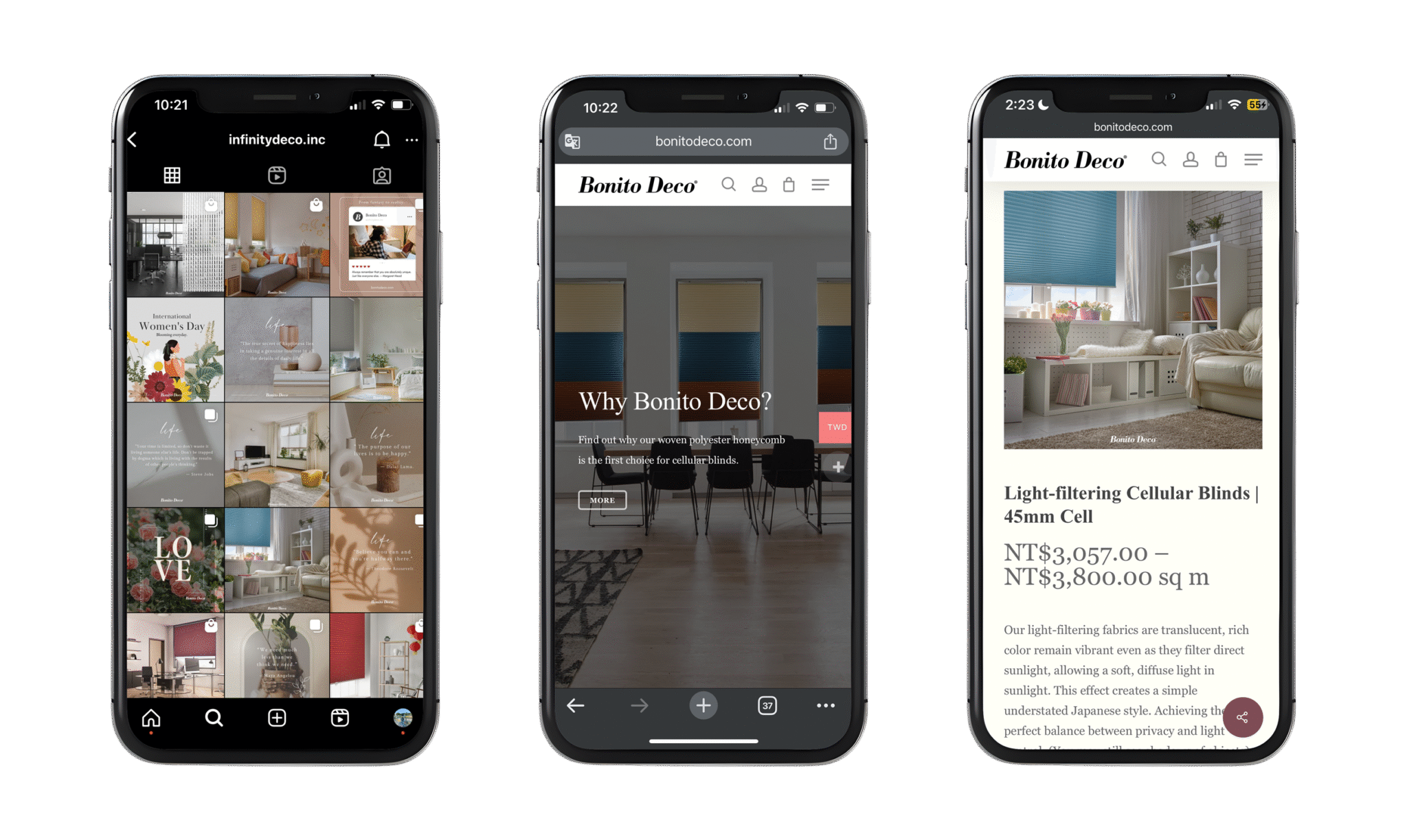
- Repositioned the brand as elegant and lifestyle-focused through typography and tone
- Key words: elegance, calm, and lifestyle quality.
- Selected serif fonts and low-saturation Morandi colors to evoke quality and calm, and convey softness and professionalism.
- Created a new logo and packaging tone that felt minimal yet sophisticated.
- Extended the visual system consistently across website, social media, and blog visuals.
5. Collaboration & Implementation
- Outlined feature requirements and discussed feasibility with a freelance developer.
- Prioritized essential functions like custom size input, automated shipping logic, and responsive layout.
- Maintained weekly check-ins and visual reviews via Google Meet to track progress and resolve blockers.
6. Content Optimization & SEO
- Rewrote all product descriptions with clarity and warmth, removing jargon and emphasizing benefits.
- Built a blog strategy around seasonal themes, styling ideas, and buyer guidance to support organic SEO.
- Designed content templates using Illustrator and Photoshop to support consistent storytelling.
7. Testing & Iteration
- Ran internal usability tests with two non-design teammates to simulate first-time user flow.
Adjusted microcopy, visual hierarchy, and mobile responsiveness based on feedback. - Added post-purchase confirmation steps and revised CTAs to improve clarity.
8. Key Outcomes
- Launched a full-function e-commerce site supporting custom orders and global shipping
- Resolved user drop-off issues by simplifying the checkout journey
- Strengthened brand consistency and professional appearance
- Delivered the entire project remotely via Google Meet, showcasing agile collaboration and coordination
- The redesign did not lead to orders because the product itself lacked a competitive edge; this taught me that UX improvements cannot make up for a weak product-market fit
My Reflection
I was honoured by this opportunity to lead a brand and website transformation from scratch. As a non-design major, I discovered that good design isn’t only about aesthetics—it’s about solving problems, building clarity, and creating trust. I learned to observe behavior, simplify decisions, and deliver value with intention. I’m grateful for this project, which deepened my interest in user experience and helped shape my multidisciplinary thinking.